Fall 2026
English 365
Technical Writing
In this asynchronous online course, you’ll develop the skills necessary to communicate complex information clearly and effectively in professional contexts. To do so, we’ll practice understanding how to identify the audience, purpose, and context for professional communications, as well as learning their standard formats and modes. We’ll think of communication as a process, editing and proofreading for style and correctness, and we’ll conduct and reference research to inform, instruct, and persuade. The bulk of our projects will center on advocating for an issue on our campus. By the end of the course, you’ll have a portfolio of sample communications that you can use for professional opportunities.
Fall 2026
English 550
Studies in Nineteenth-Century American Literature
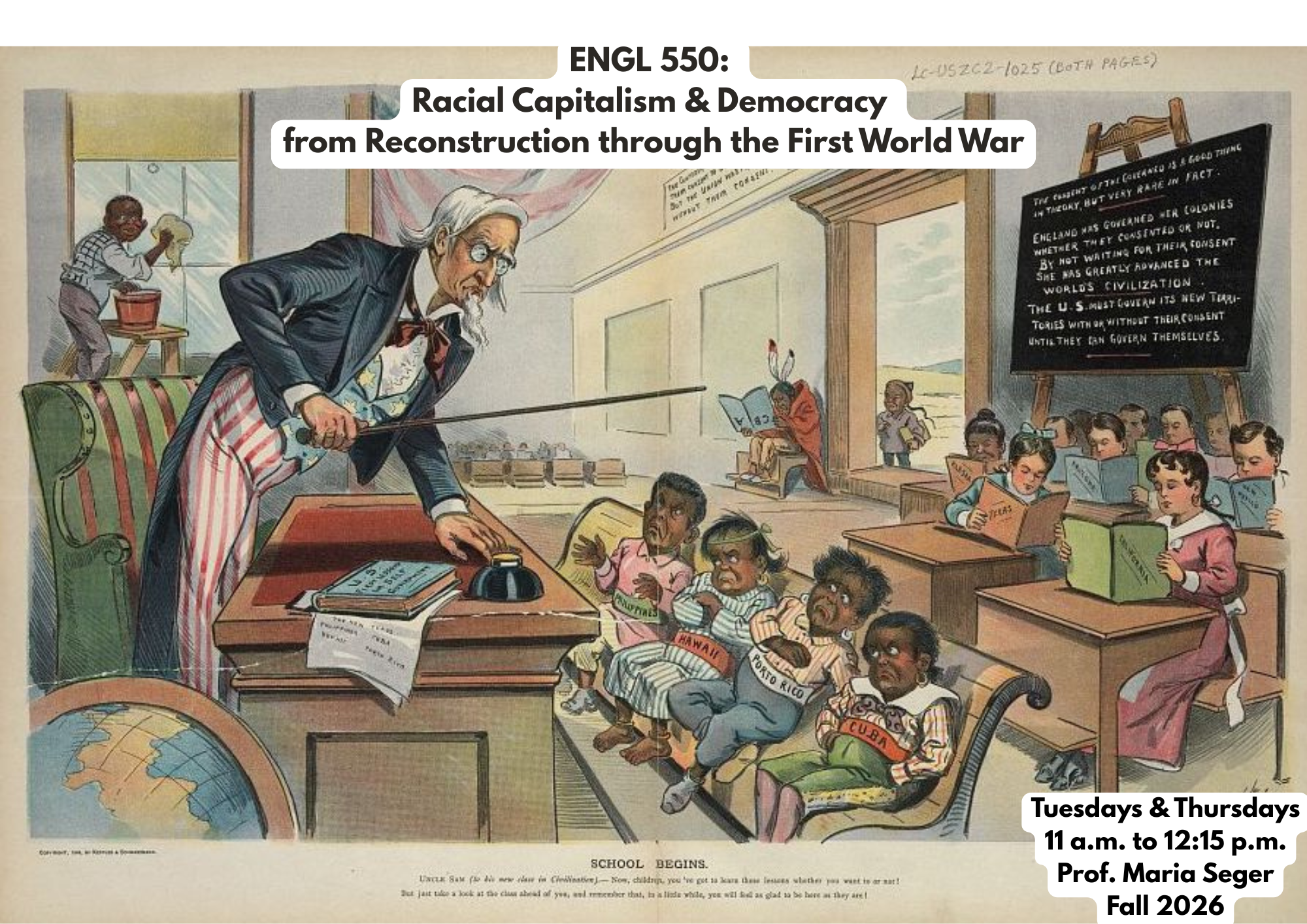
Racial Capitalism and Democracy from Reconstruction through the First World War
This seminar investigates how racial capitalism—the notion that “racism enshrines the inequalities that capitalism requires,” in the words of Jodi Melamed—animates the US literary and cultural imaginary from Reconstruction (1863–77) through World War I (1914–18). In doing so, it necessarily examines how the development of racial capitalism impacted the conception and execution of democracy in the United States, especially during westward (and later global) imperialism, Jim Crow, the Gilded Age, and the Progressive Era. If democracy is, as Fred Moten has described it, “government in which the common people hold sway,” how has racial capitalism impacted the practice of democracy? What does democracy look like in a racial capitalist nation, and what remains foreclosed, and for whom, within its structures? Informed by the theories and methods of critical race and ethnic studies, we’ll attend to the work of authors such as Anna Julia Cooper, Rebecca Harding Davis, W. E. B. Du Bois, Sutton E. Griggs, Frances E. W. Harper, Ohiyesa, Pauline Hopkins, William Dean Howells, María Amparo Ruiz de Burton, Sui Sin Far, Mark Twain, Ida B. Wells-Barnett, Sarah Winnemucca, and Zitkála-Šá to consider how US literary and cultural texts understood and responded to the structural inequities and unresolved tensions of one of the most tumultuous periods of US history. Seminar assignments include leading seminar discussion, scaffolded writing assignments culminating in a conference presentation and research article, and a public humanities project.